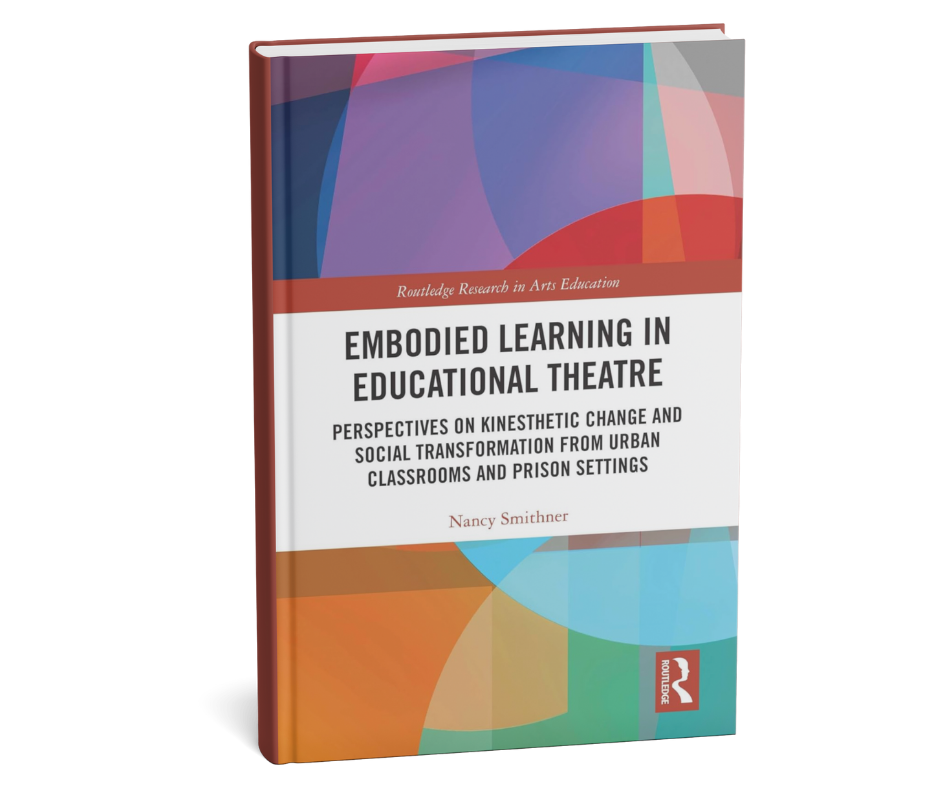
Embodied Learning in Educational Theatre
“Carefully researched and richly grounded in both theory and decades of lived practice, the book masterfully weaves together insights from Boal, Freire, and Bourdieu with the author’s own teaching experiences across schools, prisons, and communities.”
- Dr. David Montgomery, Associate Professor of Educational Theatre, New York University
“This book should be a core text for educators, activists, theater directors and facilitators who use performance to transform students and communities.”
"Smithner provides a useful framework for understanding why physical theatre approaches can be so powerful: the body is not simply a tool for expressing learning but a place where learning itself is generated.”
"What emerges most strongly is how this kind of practice can foster a culture of hope. In Smithner’s hands, theatre becomes social change at a grassroots level, something that lives in the room and ripples outward into the wider community.”
- Alice Nelson, Assistant Professor and Area Head of Theatre Arts, University of Texas at Arlington
“This is a text I will be referencing frequently, not only to expand my own understanding, but to introduce the links between physical practice and healing, transformation, and depth of work to students and colleagues.”
"Her chapters on working in prison are critical to understanding how this unique environment affects embodied learning for the students and the teachers."
- Katherine Vockins, RTA Founder & Executive Director Emeritus
Click here for NYU Steinhardt News Article on “Embodied Learning in Education Theatre”
About the Book:
This book explores the author’s unique experience teaching both applied and physical theatre in diverse classroom environments. Placing great emphasis on the importance of kinesthetic expression and the mind/body connection, it highlights the ways that physicalized pedagogy can be effectively used to promote ethical exchange and multicultural awareness, with the belief that all students can change and grow.
In this age of technology and social media, the book offers an accessible and compelling description of how facilitators can encourage empathy, understand difference and promote listening through embodiment. An important source for educators, activists, theatre directors and facilitators, Embodied Learning advocates for the use of improvisation, play and humor as powerful tools for collaborative engagement and social transformation, therefore fostering a culture of hope.
Excerpts from the Book:
“In these tumultuous times, often dependent on social media and use of distance learning, I believe the theories and practices of embodied learning can greatly enhance the classroom as a space of possibility and hope.”
"The main focus of my work is on full-bodied expression in a somatically based practice, which leads a performer to acquire a new way of being, drawing on memory, imagination, empathy and profound spontaneity.”
"The act of theatre making in a correctional facility forced us to intentionally engage with wild contradictions, the most salient of which was that creativity could thrive in the most punitive of environments.”
Full Endorsements & Reviews
“Dr. Nancy Smithner has written an urgently necessary and useful book that centers embodied practices as crucial in educational and community-based spaces to inspire and reach the most marginalized people. Her work and theories add to the swell of research that acknowledges the ways trauma and tension live in our bodies and how performance-based practices can support healing and empowerment. This book should be a core text for educators, activists, theater directors and facilitators who use performance to transform students and communities.”
-Dr. Dana Edell, Faculty Director of EmersonTHEATRE; Assistant Professor of Performing Arts, Emerson College
“Embodied Learning in Educational Theatre makes a vital contribution to the field, offering a timely exploration of how kinesthetic awareness can foster personal, social, and cultural transformation, especially in post-pandemic educational contexts. Carefully researched and richly grounded in both theory and decades of lived practice, the book masterfully weaves together insights from Boal, Freire, and Bourdieu with the author's own teaching experiences across schools, prisons, and communities. Dr. Smithner's engaging and accessible writing style invites readers—educators, artists, and activists alike—into a thoughtful and ethical examination of embodiment, making complex ideas tangible through wonderfully vivid examples, narrative, and pedagogical reflection.”
-Dr. David Montgomery, Associate Professor of Educational Theatre, Steinhardt, New York University
“This is, across the board, an important book. Part manual, part research overview, part “did you know about this??,” this is a text I will be referencing frequently, not only to expand my own understanding, but to introduce the links between physical practice and healing, transformation, and depth of work to students and colleagues. As an applied theatre practitioner, this book is hugely valuable, not only providing insight into WHY (physiologically speaking) the work we do has the impact it does, but detailing specific methods, workshops, activities, and overall practices.”
- Dr. Gina Grandi, Assistant Professor of Theatre, Appalachian State University; Co-founder of the Bechdel Group
“Embodied Learning in Educational Theatre, it does provide an excellent overview of the challenges and gratification that come out of sharing knowledge and practicum with the incarcerated. Her chapters on working in prison (An Overview of Mass Incarceration, The Carceral Body and Teaching Theatre in Prison) are critical to understanding how this unique environment affects embodied learning for the students and the teachers. Her chapters on Rehabilitation Through the Arts (RTA) and a Prison Tale describe years of workshop and production service, data collection and observable facts Nan and her students shared with our organization and the men and women we serve behind prison walls.”
-Katherine Vockins, RTA Founder & Executive Director Emeritus
“One of the most compelling aspects of Nancy Smithner's Embodied Learning in Educational Theatre is its central argument that learning happens not only through the mind but through the body. As a University Professor in theatre education who has taught in both Canadian and American university settings, and whose creative practice-as-research involves devising physical theatre with adults with intellectual and developmental disabilities (IDD), I found myself both inspired by Smithner’s research, nodding along throughout much of the book.
Smithner's emphasis on embodied knowledge reflects much of what I have observed in my own work facilitating devised and physical theatre processes. Many of the actor-creators I work with communicate, create, and make meaning in ways that challenge traditional text-centered approaches to theatre. In these spaces, some of the richest learning does not emerge from discussion around a table but from physical experience.
Smithner provides a useful framework for understanding why physical theatre approaches can be so powerful: the body is not simply a tool for expressing learning but a place where learning itself is generated.
Smithner frames her expertise within a tradition of “standing on the shoulders of giants,” while also giving us a clear sense of the key thinkers and practitioners who have shaped the field. I was especially drawn to her account of working as a teaching artist at Sing Sing Prison, and her use of humor and improvisation as genuine tools for transformation, not just techniques. She describes her practice as “providing aesthetic tools that promote spontaneity, empathy, and cooperation through full-body expression,” which really resonates with the kind of embodied, ensemble-based work many theatre educators are engaged in. I also appreciate her honesty about the environments she works in, particularly the complexity of embedded power dynamics and what it actually means to facilitate in those spaces. What emerges most strongly is how this kind of practice can foster a culture of hope. In Smithner’s hands, theatre becomes social change at a grassroots level, something that lives in the room and ripples outward into the wider community. For those of us committed to applied and embodied theatre practices, Smithner’s shoulders are ones to stand on.
Ultimately, Embodied Learning in Educational Theatre is an argument for a broader understanding of how people learn, connect, and change. For educators working in applied theatre, community-engaged performance, disability arts, or devising practices, the book offers both a valuable theoretical framework and a welcome affirmation of work that often resists easy measurement. It reminds us that some of the most meaningful learning happens when people are invited not simply to think differently, but to move, play, imagine, improvise and create together.”
- Alice Nelson, Assistant Professor and Area Head of Theatre Arts, Department of Theatre Arts and Dance, University of Texas at Arlington